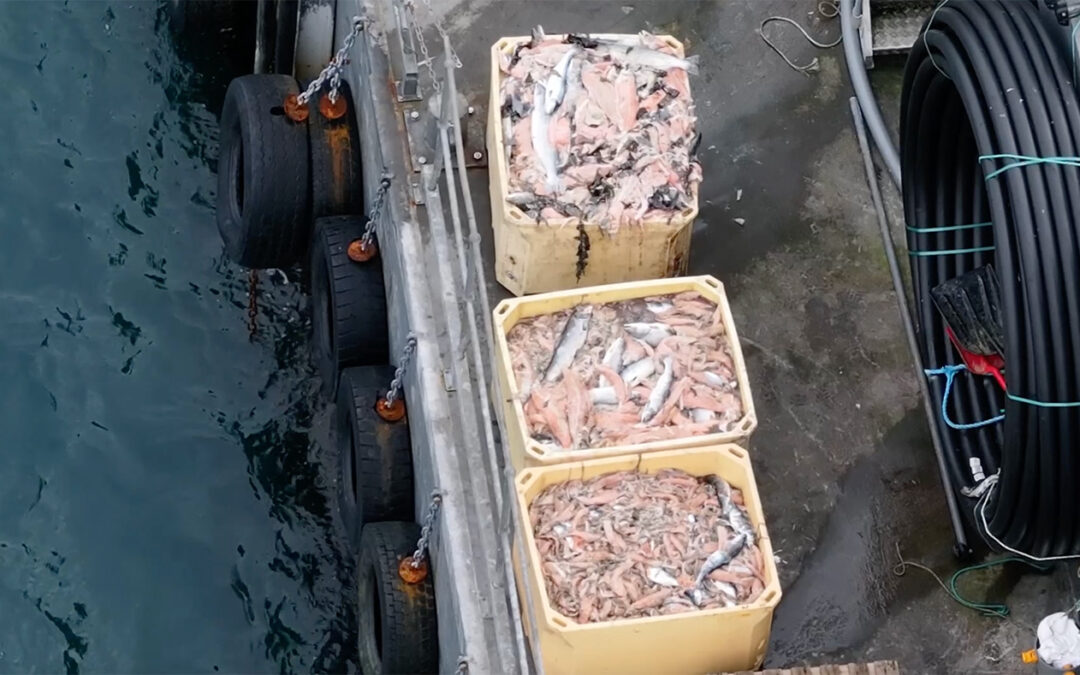
Hundreds of thousands of Atlantic salmon (Salmo salar) died on fish farms in Scottish waters in the final months of 2024.
In January, a parliamentary committee concluded an inquiry into the industry, saying it was “disappointed” by the lack of progress on environmental pollution and animal welfare issues.
Hundreds of thousands of Atlantic salmon (Salmo salar) died on fish farms in Scotland in the final months of 2024. The mass mortality events took place as a parliamentary committee concluded an inquiry into the industry, saying it was “disappointed” by the lack of progress on environmental pollution and animal welfare issues.
Among the most striking incidents recorded by the Scottish Fish Health Inspectorate, 59,000 adult salmon died between September and October 2024 at a farm in Loch Torridon owned by Norwegian multinational Mowi that Mongabay visited in September. The main causes of death were gill disease and mechanical treatments to remove parasitic sea lice (Lepeophtheirus salmonis). Due to this and previous incidents, in the 18-month production cycle ending in October, the farm, which can hold at least 2,500 metric tons of salmon at a time, declared a 30% loss of production.
Even more salmon died on other farms. Between September and November, 323,000 dead salmon were reported at the Invertote farm on the Isle of Skye, owned by local company Organic Sea Harvest. Many of these deaths, the company reported, were due to string of pearls jellyfish (Apolemia uvaria), whose poisonous tentacles can wound salmon’s skin, eyes and gills.
This jellyfish is also responsible for several episodes at the Mowi farm on the Isle of Muck, where 272,000 salmon died between October and November, either as a direct result of injuries or due to the emergency transfer of fish to other sites.
“In the last couple of years, my company moved 1.8 million fish in about 10 days away from the jellyfish, because that is all you can do,” Ben Hadfield, Mowi Scotland’s chief operating officer, said during a hearing Dec. 4 before the Scottish Affairs Committee of the U.K.’s House of Commons.
In his speech, Hadfield said the same jellyfish had started a record outbreak, which during the last production cycle that began in early 2023 killed 1.1 million fish at a site in Loch Seaforth, in the Outer Hebrides.
“We did everything we possibly could to reduce the density, to stop feeding, to try to bathe the fishes’ gills in freshwater. We did our absolute best for the fish, as you would, and we still experienced that very high level of mortality,” he said.
The same jellyfish reportedly killed millions of salmon at Norwegian farms in recent years.
Repeated mass mortality incidents are one of the main concerns emerging from the inquiry the Rural Affairs and Islands (RAI) Committee of the Scottish Parliament conducted between April and December 2024 and published in January.
“The committee is concerned that preventing high mortality events is not currently within the operational capability of industry,” the report stated. It called on the Scottish government “to limit or halt production at sites which record persistent high mortality rates.”
The RAI Committee’s inquiry aimed to assess the industry’s progress in response to a previous inquiry in 2018 that required it to address fish health and environmental challenges, and the government to improve regulation. The industry said it has invested 1 billion pounds ($1.24 billion) in measures to improve fish health and welfare since 2018. The committee, however, said that “mortality has not improved” in the same period.
“What we’ve got right now is not acceptable,” Finlay Carson, Scottish MP and chairman of the RAI Committee, told Mongabay.
According to Carson, the committee found some improvements in certain areas, “but the pace hasn’t been fast enough” and the problems are still there. Chief among them are the high mortality, the environmental impact and the effect on wild salmon, and new challenges are approaching, such as climate change and rising water temperatures.
“There remain uncertainties and knowledge gaps in understanding the environmental impact of waste discharges from salmon farms,” the report said.
Rachel Mulrenan, director of the NGO WildFish in Scotland, said she agreed with most of the committee’s conclusions, but “they still fall short of recommending a moratorium on growth of the industry,” which is expanding in the country.
“That is a widely supported position, and it’s quite uncontroversial to not allow a polluting industry to expand until it addresses all the issues it is facing,” Mulrenan told Mongabay.
The RAI Committee gave the government and the industry a 12-month deadline to respond to 65 new recommendations, including a review of the regulatory framework to reduce mortality, environmental impact and other issues, and a guarantee of more transparency. According to Carson, after this period, it will conduct a new review to assess the progress and then could consider an overall moratorium.
This story was also published on: