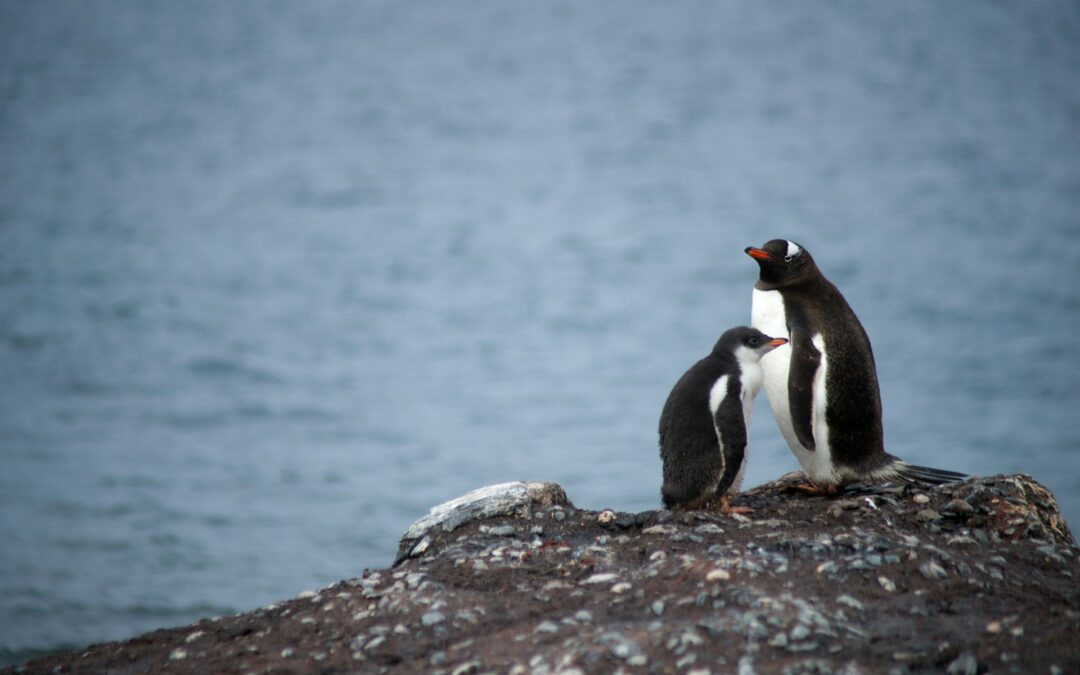
Despite a year of interim negotiations, CCAMLR members failed again at the latest meeting to reach agreement on creating any new marine protected areas and rolled back regulation of the burgeoning Antarctic krill fishery.
The international body in charge of conserving marine life in Antarctic waters has failed again to reach agreement on creating new marine protected areas in the Southern Ocean and rolled back regulation of the burgeoning Antarctic krill fishery.
The Commission for the Conservation of Antarctic Marine Living Resources (CCAMLR) held its annual meeting Oct. 14-25 in Hobart, Australia. According to several observers, the growing commercial interest in krill fishing collided with concerns about the impact of climate change on regional ecosystems and prevented the 27 members of the CCAMLR from reaching any agreement, despite a year of negotiations.
Conservation groups expressed disappointment at the results. “We leave the 43[rd] annual meeting of CCAMLR disheartened by the expiration of crucial measures to protect Antarctic marine living resources, a decision driven by a minority of Member States,” Holly Parker Curry, a campaign director with the Antarctic and Southern Ocean Coalition (ASOC), an international group of NGOs advocating for the creation of protection measures in the region, told Mongabay in an email.
“This setback not only threatens critical ecosystems but also highlights a troubling erosion of nations collective commitment to conservation and the collaborative spirit that underpins the Antarctic Treaty System,” Parker Curry said.
During the meeting in Hobart, China and Russia vetoed a proposal for a new marine protected area (MPA) in the Western Antarctic Peninsula and blocked the renewal of Conservation Measure 51-07 (CM 51-07), which distributed krill-fishing activities within designated sub-areas of the expansive krill-fishing area to avoid overly intensive fishing.
“The non-renewal of CM 51-07 is a step backward for the Commission’s work and once again exposes predators to the concentrated impact of fishing,” Rodolfo Werner, who attended the CCAMLR meeting as an observer, told Mongabay in an email minutes after the summit closed.
“Additionally, China’s refusal to allow the MPA to move forward represents another setback for the Commission,” said Werner, science and policy adviser for the Pew Bertarelli Ocean Legacy, a partnership between U.S.-based NGO Pew Charitable Trusts and Swiss philanthropist Dona Bertarelli.
A pledge for biodiversity
The CCAMLR, part of the Antarctic Treaty System, was set up in 1982 in response to growing concern over the potential impact on marine life of unregulated fishing for krill (Euphausia superba) in the region.
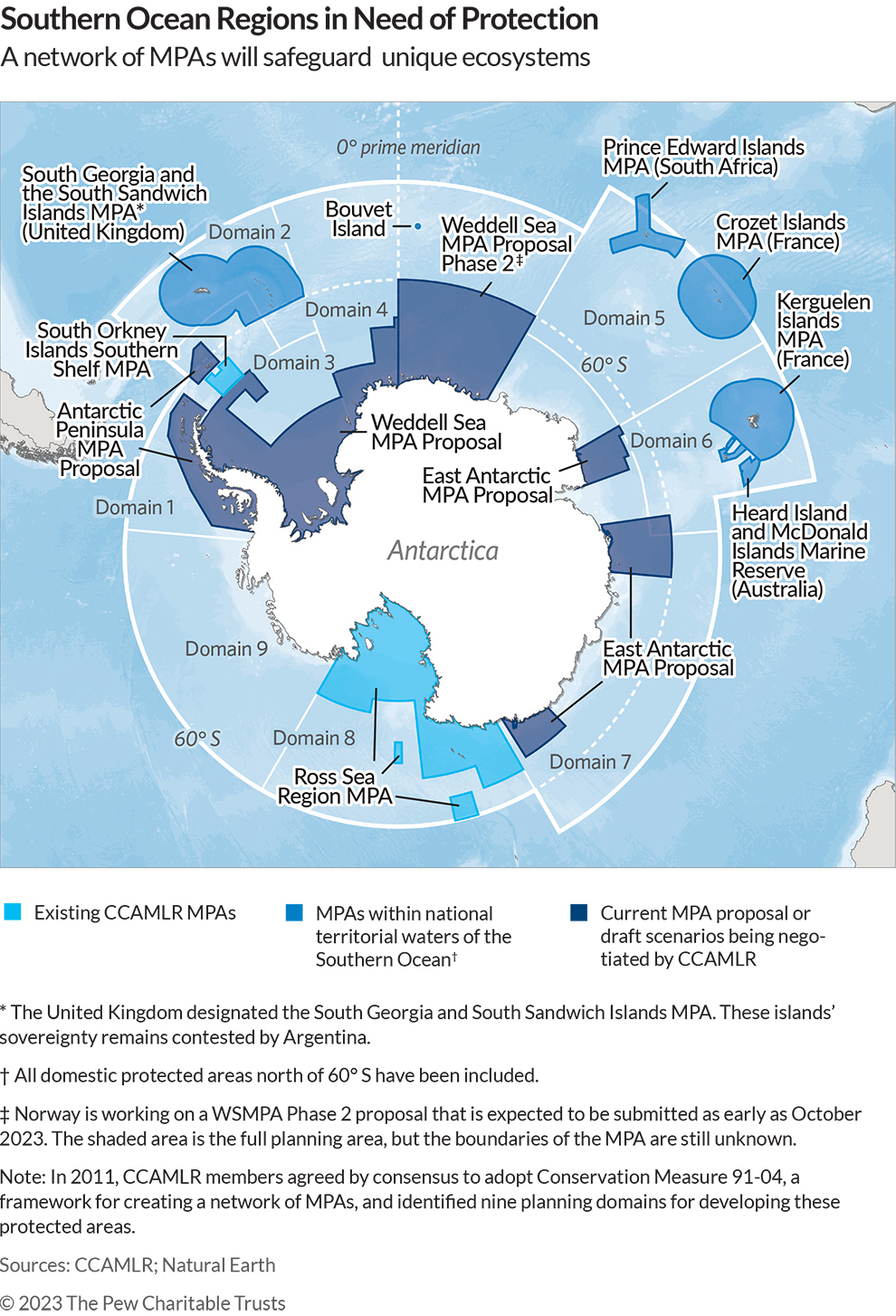
In 2009, CCAMLR members pledged to create “a representative network of MPAs” in the Southern Ocean. The body established MPAs on the southern shelf of the South Orkney Islands that year and in the Ross Sea in 2016. But four proposed MPAs in the Weddell Sea, East Antarctica and the Antarctic Peninsula have been at a standstill for years, due to repeated vetoes by the Chinese and Russian delegations.
If approved, these areas, along with the existing Ross Sea MPA, would safeguard 26% of the Southern Ocean and nearly 3% of the global ocean. This would contribute to achieving the 2022 Kunming-Montreal Global Biodiversity Framework (GBF), which commits nations to protect 30% of the world’s ocean by 2030.
The CCAMLR meeting overlapped with the U.N. Biodiversity Conference, being held Oct. 21 through Nov. 1 in Cali, Colombia, with the aim of implementing the GBF agreement. Twenty-six of the CCAMLR’s 27 members signed the GBF in Montreal, including Russia and China, with the only exception being the United States.
“They all believed in a world where 30% protection is needed and achievable,” Matt Spencer, author of the ASOC report “Protecting a Changing Southern Ocean,” told Mongabay. “It has been proven that large-scale and well designed MPAs, with strong levels of protection, do increase species biomass, genetic diversity, and in turn this enhances species resilience to environmental impact, such as climate change.”
“In Antarctica and the Southern Ocean 2022 and 2023 were really poor years with sea ice, we’ve seen massive ice losses, extreme weather events, marine heatwaves becoming more pronounced and more common, and more acidifying waters,” Spencer said.
According to Spencer, in the polar regions global warming is “between double and four times the warming on the planet” and this is affecting wildlife. “Krill, which is probably the most important species in the Southern Ocean, is already seeing their range contracting, they are moving polewards,” he said.
A deal with the fishery
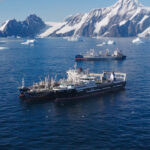
Krill are shrimp-like zooplankton that live mainly in schools. They’re the foundation of the food web for most wildlife in the Southern Ocean, from whales to penguins to flying seabirds. Commercial fishing for krill has grown in recent years, reaching a record 498,000 metric tons in 2023. The growth is driven by rising demand for aquaculture feed. China is the world’s leading producer of aquaculture products and the No. 2 fishing country for Antarctic krill, after Norway.
To make progress on managing the fishery and break the stalemate on the MPAs, in July a “Harmonization Symposium” took place in Incheon, South Korea. The U.S. and South Korea led the meeting, which was funded by ASOC and the Association of Responsible Krill harvesting companies (ARK). The latter represents eight companies from four CCAMLR member countries (China, Chile, Norway and South Korea) and more than 90% of all krill catches in CCAMLR waters.
The aim of the meeting was to reach a deal to adopt a revised management approach for the krill fishery that would allow higher and more flexible catch limits in exchange for a consensus to establish the long-sought MPA in the Western Antarctic Peninsula.
“A ‘package deal’ seems necessary to advance both initiatives,” the introductory note to the meeting in South Korea reads.
According to Werner, the Incheon meeting was a success: “The Chinese delegation was present at the [South] Korea meeting, and all indications suggested that they were in favor of moving forward, approving the new catch limits from the Harmonization Symposium, and likely agreeing to establish the MPA,” he told Mongabay.
The proposed agreement then reached the meeting in Hobart, and that’s when things fell apart.
“Some CCAMLR members, once the meeting started in Hobart, seemed to have changed their mind about the agreement made in [South] Korea and they proposed even lower krill catch limits,” Werner said. “The insistence of these members on imposing lower catch limits led the Chinese delegation to withdraw from the potential agreement.”
The failure of the deal pushed China to also block the renewal of the current krill fishing measure, CM 51-07, Werner suggested. In its absence, only a previous conservation measure, CM 51-01 remains in force, which establishes the catch limit at 620,000 metric tons per year for the whole krill-fishing area, known as Area 48, without distributing it among the sub-areas.
Because fleets will now be able to fish wherever they want within Area 48, catches are likely to rise toward the limit, which has some scientists and conservationists worried.
“This year, the krill catch in [Area 48] has exceeded 498,000 tonnes, which is very high,”
Laura Ghigliotti, a researcher at the National Research Council of Italy and member of the CCAMLR’s scientific committee, told Mongabay in an email. “This is particularly concerning when considering the ongoing environmental changes (and resulting changes in sea ice dynamics).
“Unfortunately, the consensus rule (which … is stringent at CCAMLR) based on negotiation and reaching compromises to the satisfaction of all … in the current geopolitical context makes any progress extremely difficult,” Ghigliotti added.
Mongabay reached out to the Chinese and Russian delegations as well as to ARK for comment for this story, but none responded by press time.
Banner image: Antarctic terns (Sterna vittata), the start of whose nesting coincides with the start of the krill bloom. Image by Gregory “Slobirdr” Smith via Flickr (CC BY-SA 2.0).
(Photo by Torsten Dederichs on Unsplash)
This investigations was also published on: