The project of the Italian tuna fishing industry in Cetara (SA) could begin its operations as early as 2026
by Francesco De Augustinis
In the municipality of Cetara, a small gem nestled at the southern tip of the Amalfi Coast, in the gulf overlooking Salerno, preliminary work has begun on the construction of a bluefin tuna fattening plant, which could become operational as early as the summer of 2026.
“Buoys have been placed in the waters off Cetara to collect biological data from the sea and currents,” Daniela Borriello, National Director of Coldiretti Pesca, told us. Coldiretti Pesca is an Italian fisheries association representing 50% of Italy’s bluefin tuna fishing fleet and is behind the initiative, supported by several bluefin tuna fishing companies.
“This data is currently being collected; it will take a few more months to see the results,” Borriello continued. “At that point, once the data proves positive, we will move on to the more bureaucratic steps: securing the concession for the body of water, which operators must request from the Municipality of Cetara, since the designated area is directly opposite the town,” she added.
The administration of the small fishing village has not only endorsed the project but has also actively promoted it. “Between Cetara and Salerno, there are 15 of the 20 boats currently licensed to fish bluefin tuna in Italy,” Mayor Fortunato Della Monica told us. “They’ve decided to close the supply chain. Naturally, I support the shipowners in their efforts,” Della Monica said.
Where does this idea come from
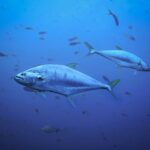
In 2025, the bluefin tuna quota allocated to the Italian fleet was 5.2 thousand tonnes. Of this total, based on the distribution established by the Italian Ministry of Agriculture, Food Sovereignty and Forestry, the vast majority (almost 80%) was assigned to the 19 Italian vessels authorized for purse-seine fishing (3.6 thousand tonnes) – the so-called “flying tuna nets,” which capture schools of tuna by encircling them with nets up to 2 km long – and to the two fixed tuna traps (415 tonnes) still operating in Sardinia. Both of these fishing systems catch tuna alive and then transport them to fattening facilities in Malta or, more rarely, Spain, where the fish are held in cages for three or four months, fattened, and subsequently sold to Asian markets, particularly Japan, where Mediterranean bluefin tuna is highly sought after for sushi.
In recent years, however, this model has begun to falter due to declining prices. “The Japanese market may have reached saturation point,” said Tristan Camilleri, technical advisor to the Maltese Producers’ Federation. “Japan’s economic difficulties, the increase in fish on the market… ultimately, the price drops,” Camilleri said. According to the Maltese expert, the situation is likely to become even more complicated following the latest meeting of the International Commission for the Conservation of Atlantic Tunas (ICCAT), the international body that allocates Atlantic tuna fishing quotas, which decided on a sharp increase in quotas for eastern Atlantic and Mediterranean bluefin tuna over the next three years – from 40,000 to 48,000 tonnes – laying the groundwork for a significant rise in production in several countries.
According to Coldiretti, establishing a bluefin tuna fattening plant in Italy is a response to this crisis, creating the basis for a supply-chain project dedicated to large-scale purse-seine vessels. The tuna produced would be destined directly for Italian and European restaurant and retail markets, which until now have been supplied only by longline vessels or small-scale coastal fishing boats.
More details about the plant
Only partial details of the project are currently known. The promoters remain tight-lipped about its capacity: “It’s a medium–large facility,” says Borriello, who explains that in its initial phase it will be supplied with the entire catch of three vessels belonging to the company that submitted the proposal.
The application to install the monitoring buoys was submitted by the Tonno Rosso d’Italia producers’ organization, which includes the company Pappalardo Salvatore Aniello and the associated company Adriafish.
In 2006, a procedure for a similar bluefin tuna fattening facility was initiated in Cetara, but later abandoned, partly due to a legal dispute with the neighboring municipality of Maiori, which was concerned about potential impacts on its waters—an area strongly oriented toward tourism and bathing.
The new farming project, according to Mayor Della Monica, is located more or less in the same area as the previous one: “It has moved closer to the Maiori area,” he said, “but remains within Cetara’s waters. It has been shifted about a mile, so to speak, but it’s essentially the same area.”
The environmental impact
The tuna fattening plant in Cetara would be the first operational in Italy, after several attempts to build similar facilities along the Italian coast in recent years have failed. This is largely due to the specific conditions required for this type of production: clean marine areas with appropriate currents but still close enough to the coast to avoid storm surges. In Italy, however, such coastal areas tend to be highly touristic, making them difficult to reconcile with intensive aquaculture and often leading to concerns and conflicts over environmental impact, as occurred with the nearby plant in Marina di Camerota, in Cilento, which is currently inactive.
The history of fish farming in other Mediterranean countries is also marked by environmental issues, particularly in tourist areas. In Malta, the most recent incident occurred in August 2025, when an oily sludge produced by fish farms polluted the beaches of several seaside resorts, including Sliema on the island’s eastern coast, keeping tourists and swimmers away for days.
“Tuna produce constant waste, and their feces often have a high oil content, which contributes to the formation of slicks on the water’s surface,” explains Tristan Camilleri, technical advisor to the Maltese Producers’ Federation. According to Camilleri, companies in Malta regularly remove the sludge produced by the farms, but occasional leaks can lead to accidents such as the one that occurred in August.
Another environmental concern involves the use of large quantities of wild fish as feed. Frozen fish such as sardines, mackerel, and anchovies are used in tuna fattening plants, at a ratio of 10 to 25 kg of wild fish for every kilogram of tuna produced.
According to Coldiretti, the Cetara facility would be able to address both problems by adopting a different feeding system: “This new farm will use a different, leaner, more sustainable, and lighter diet,” said Borriello. Specifically, the project calls for replacing whole frozen fish with feed pellets, which would allegedly reduce the amount of raw material needed and lower the environmental impact. This alternative feeding method would also produce less fatty tuna, making them more suitable for the European market.
To date, however, this technology has never been successfully applied in industrial-scale fattening of adult tuna. “It’s very difficult to use. We tried it, but the fish didn’t eat it,” said Camilleri, referring to Malta’s attempts. “There are other research-scale projects that have had more positive results, but there is no experience at industrial scale.”
Since there are no precedents, there are also no studies on the actual environmental impact associated with this type of feed. “Much more than frozen fish, some extruded feed (pellet feed) risks sinking beyond the mesh at the bottom of the tank and accumulating under the cages, causing pollution if the cages are not positioned at the proper distance from the seabed and in areas with adequate water circulation,” Roberto Mamone, an expert consultant in aquaculture systems, wrote to us in an email.
No environmental impact assessment required
In any case, the Cetara plant is planned to occupy a surface area of less than 50,000 m², the minimum threshold above which fish farming facilities – according to European regulations – are required to undergo an Environmental Impact Assessment (EIA).
Therefore, as Coldiretti’s Borriello explained, the authorization process “remains in the hands of the Municipality,” which is the only authority that must give the green light, albeit on the basis of non-binding assessments concerning potential environmental impacts.
In the early 2000s, Greenpeace Italy opposed the previous tuna fattening project in Cetara. According to Alessandro Giannì, Head of Institutional and Scientific Relations for the NGO, the plant raised concerns because of its location: “It was practically at the exit of the port of Salerno,” he said, meaning “these animals would have been subjected to constant stress, not only from pollution but also from the noise of passing vessels.”
The association maintains that even today a regulatory vacuum remains regarding the environmental impacts of such facilities. “There are guidelines” for aquaculture facilities, Giannì said, “but they were issued not by the Ministry for the Environment, but by the Ministry of Agriculture. Not only that, but those guidelines don’t apply to tuna farms,” he added.
The Cetara project is not the only one currently under way in Italy, although it appears to be the most advanced. Just a few weeks ago, Greenpeace reported that Italy had declared more than 8,000 tonnes of bluefin tuna in fattening plants to the ICCAT database, while actual production is currently zero. According to the table submitted by Italy to the international authority, 7.5 thousand tonnes of tuna are declared as being produced in facilities located within the Ministry of Agriculture in Rome.
The Ministry responded to the NGO by stating that these are currently inactive plants, whose presence in the database “represents part of the authorized fattening capacity attributed to Italy, which is redistributed to active fattening farms.”
“It appears that the system is being used by the Ministry to reserve future quotas,” said Giannì, who has written to the European Commission seeking clarification on the matter.
(cover photo: Alessandro Giannì/Greenpeace Italia)
This story was also published on: