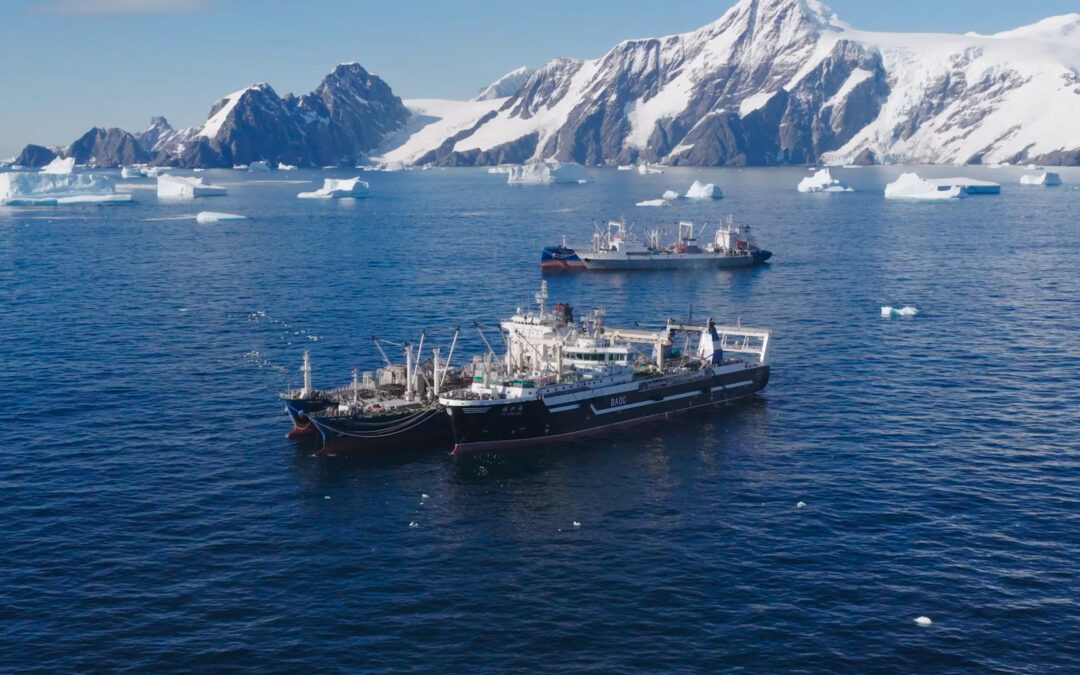
China and Norway are working to expand the Southern Ocean krill fishery, promoting a new management system for the fishery that would increase harvests while also establishing a long-sought marine protected area.
Francesco De Augustinis
China and Norway are working to expand the Southern Ocean krill fishery, promoting a new management system for the fishery and continuing to support their fleets politically and financially. Meanwhile, tensions are escalating between environmental NGOs and the fishing industry, as it targets a species at the heart of the food web in one of the planet’s most fragile ecosystems.
“We hope we will be able to get the decisions we need now in October 2026,” Matts Johansen, CEO of Aker BioMarine, told us in April. The Norwegian company has been involved in the fishery for years as Norway’s only operator. In 2024, it spun off Aker QRILL, which now operates the Norwegian krill-fishing fleet and harvested 52% of the Southern Ocean krill catch in the 2025 season and 63% in 2024.
The Norwegian delegation made a striking proposal at the last meeting of the multilateral body that manages fishing in the Southern Ocean, the Commission for the Conservation of Antarctic Marine Living Resources (CCAMLR), held in Hobart, Australia, in October 2025. Norway proposed moving away from a fixed catch-limit system and nearly doubling the amount of krill (Euphausia superba) that can be fished in the Southern Ocean. The 27 CCAMLR members did not reach the consensus necessary to approve the proposal.
According to Johansen, as a consequence of this refusal, the Chinese delegation reiterated its veto on a proposal to establish a marine protected area around the western Antarctic Peninsula and the South Orkney Islands, in a zone called Domain 1. The proposal, forwarded in 2017 by Chile and Argentina, has been blocked ever since by China and Russia.
“Where it stopped last year is that some nations didn’t want to accept the new quota numbers,” Johansen said. “And then China said, ‘Then we won’t accept the MPA.’”
In the months since, Aker began a campaign of diplomacy and influence to secure approval for Norway’s krill-harvesting proposal at the next CCAMLR meeting, scheduled for October 2026.
“We’re continuing to do what we did last year, which is having meetings with the governments,” Johansen said, adding that he would soon travel to China, and then on to South America and Europe, for talks.
Antarctic krill are small, shrimp-like crustaceans that form massive schools. Fishing vessels process them onboard into meal and oil that is used primarily in the production of aquaculture feed, followed by pet food and human dietary supplements, according to market analyses.
This year, catches are likely to again reach the annual CCAMLR limit of 620,000 metric tons. They did so for the first time in 2025, triggering an early closure of the fishery in August. The increase in catches is due to fleet expansion and the concentration of fishing effort around the Antarctic Peninsula and the South Orkney Islands, where krill densities are highest. These areas are also key feeding grounds for whales, penguins, seals and seabirds, which depend on krill to survive — hence the effort to protect them.
Matthew Savoca, a research associate at Stanford University’s Hopkins Marine Station in the U.S., returned in April from a research expedition focused on whale populations in the Southern Ocean aboard a vessel operated by the U.S.-based NGO Sea Shepherd. He told us he observed fishing vessels concentrated near the South Orkney Islands.
“The industry says it only takes 1% of the krill biomass,” he said. “But at what scale is that percentage being calculated? The scale is the entire southwest Atlantic Ocean, which is an area roughly the size of Europe. Yet fishing is concentrated on two pinheads. It would be like affecting just the populations of London and Paris.”
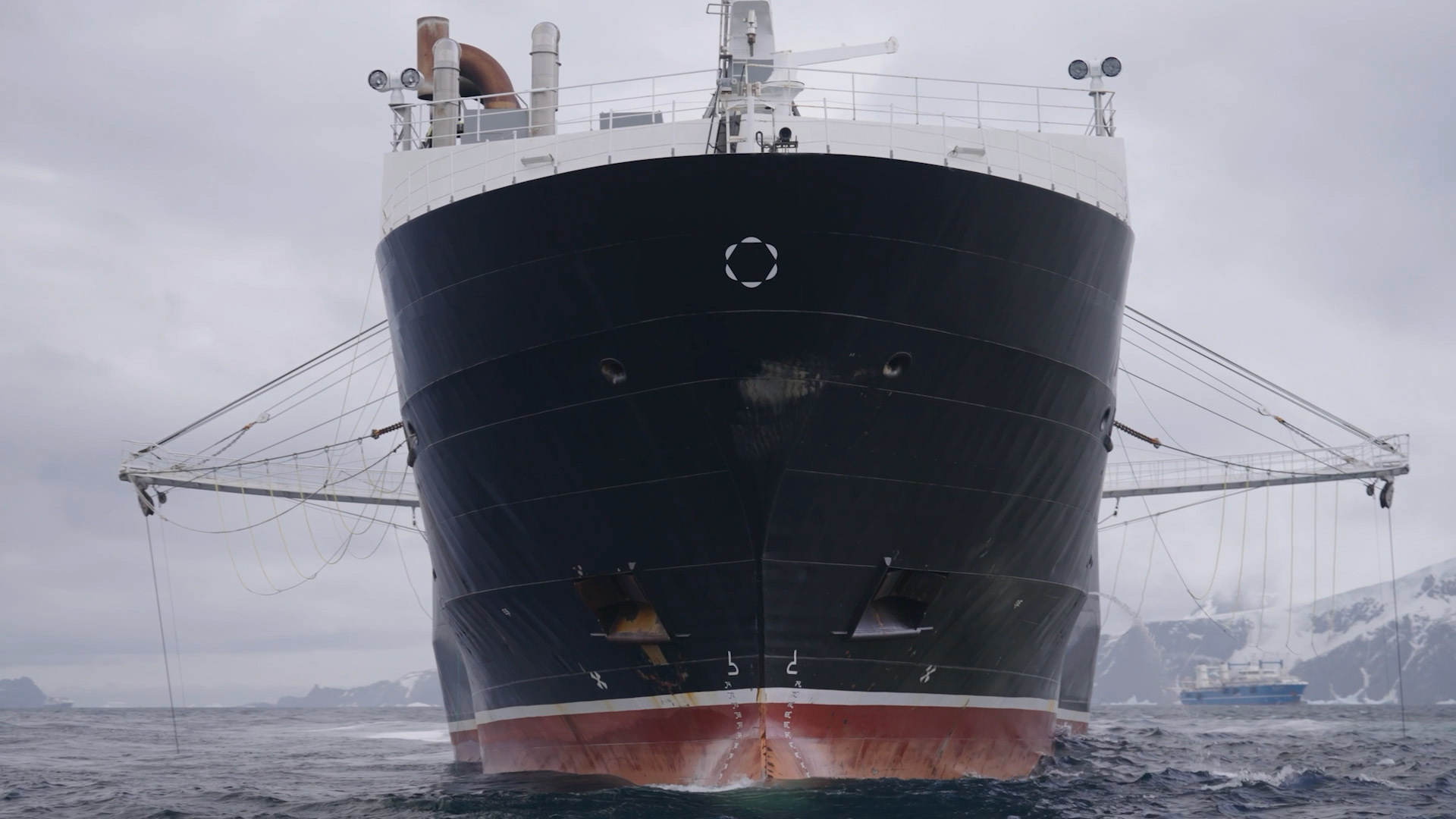
The increase in fishing capacity is being driven by the Norwegian fleet, which announced plans to launch a fourth vessel in 2026, and the Chinese fleet, which increased from four to five vessels in 2025 and licensed a sixth in 2026. This growth is linked to subsidies and other state support, especially from Chinese authorities.
Meanwhile, several NGOs have recently stepped up their campaigns against krill fishing. Sea Shepherd and the U.S.-based Captain Paul Watson Foundation sent ships to Antarctica, and in March, the latter’s vessel deliberately collided with Aker vessel Antarctic Sea. Also in March, the Antarctic and Southern Ocean Coalition, a U.S.-based advocacy group, filed an objection to the recertification of Aker’s krill fishery as sustainable by the U.K.-based certification nonprofit Marine Stewardship Council (MSC).
The NGOs argue that the krill fleet competes for food with Antarctic wildlife species already struggling with climate change and reduced food availability. These include emperor penguins (Aptenodytes forsteri) and Antarctic fur seals (Arctocephalus gazella), both deemed endangered by the IUCN’s Red List of Threatened Species in April.
Following the campaign against krill fishing, on April 28, the European Parliament approved a request urging the European Commission to support a five-year moratorium on Southern Ocean krill fishing.
The Norwegian proposal
Aker’s campaign is aimed at obtaining approval for a package of meaty measures at the next CCAMLR meeting. These include the marine protected area in Domain 1, a new krill-fishery management scheme to distribute fishing quotas spatially within and beyond Domain 1 and an overall catch increase to 1.1 million metric tons that would eliminate the current precautionary limit of 620,000 metric tons. According to a recent Aker policy document we reviewed, “future catch levels are expected to remain in the range of ~1.3–1.5% of biomass,” meaning fishing effort would increase 30-50%.
According to Aker, this package already has the support of CCAMLR’s scientific committee. To promote it, the company launched the Ocean Stewardship Initiative in January, together with the U.K.-based Sustainable Markets Initiative, founded by King Charles III, and with advisory input from the MSC.
“It started with King Charles,” Johansen said. “So when he invites different parties to come and discuss at Buckingham Palace, people will show up much more than if we, as a little company in Norway, try to do the same.”
In recent weeks, former U.S. Secretary of State John Kerry became a spokesperson for the initiative, and Aker’s CEO said “there are more champions coming on board soon.”
Members of Norway’s delegation to CCAMLR did not respond to our questions about whether they intend to resubmit the same proposal. In an email sent in October, Bjørn Krafft, Norway’s scientific representative at CCAMLR and a researcher at the Norwegian Institute of Marine Research, part of the Ministry of Trade, Industry and Fisheries, told us the Norwegian proposal does not “reflect industry demands” but is “science-driven and developed within Norway’s broader commitment to sustainable fisheries management.”
However, a ministry official characterized the industry’s role differently. “Norway, together with Member States, discuss thoroughly with the krill industry fishing in Antarctic waters how to reach a common understanding,” Elisabeth Johansen, senior adviser at the ministry, told us in a written statement. She said Norway is negotiating with China and other member states, maintaining that a path toward establishing new MPAs must accompany any increase in the annual krill quota.
Regarding government support, both the ministry and Aker told us that Norway does not grant “subsidies” to the krill fishing industry. However, Aker QRILL acknowledged in an email that it participates in “business mechanisms” not strictly related to fishing, such as “export credit schemes” designed to support shipbuilding.
A 2025 study published in the journal Frontiers in Ocean Sustainability analyzed the public support provided through these mechanisms. “Aker BioMarine, Norway’s sole Southern Ocean fishing company, has received millions of dollars in subsidies from several government agencies and banking institutions in the form of tax breaks, discounted loans, research and development grants, and infrastructure support,” the study states.
According to the researchers, the Ministry of Trade, Industry and Fisheries sets the budget for the fisheries sector but is heavily influenced by national agencies responsible for subsidy allocation, such as Innovation Norway. “We offer grants, risk loans and guarantees to Norwegian companies across all sectors, including businesses operating within the ‘Blue Transformation,’” Herman Ringstad, Innovation Norway’s communications director, told us in an email, responding to a question about incentives for the krill industry. “All our funding is granted in accordance with EU State Aid Rules,” he said.
Chinese subsidies
“China stands out as the largest contributor to fuel subsidies” for Southern Ocean fisheries, and its local authorities grant additional economic incentives for landing Southern Ocean catch, the same 2025 study states.
“A lot of the boats that are fishing in the Southern Ocean are going back and forth from China, and they are heavily subsidized in terms of fuel, in terms of tax incentives, in terms of infrastructure,” lead author Vasco Chavez-Molina, a research affiliate at the University of Colorado Boulder in the U.S., told us.
The study cites the case of the municipal government of Weihai, in Shandong province, which provides 30 yuan ($4) per metric ton of Antarctic krill, along with tax exemptions for landing catches at its municipal port.
The latest fishing trawler to join the Chinese fleet, the Yogi In, underscores the role of subsidies in the fleet’s growth. According to the Shanghai-based newspaper The Paper, the vessel cost 650 million yuan ($95.5 million), with the state-owned Wuhan Second Ship Design and Research Institute responsible for “key technology research and development work” and Xiangshan county “actively promoting” an Antarctic krill industrial park project.
“Antarctic krill is simply an untapped gold mine at sea,” Jiang Caiguo, CEO of Ningbo Eurasian Ocean Fishery Co. Ltd., which owns the vessel, was quoted by The Paper as saying. “Antarctica is the only continent in the world without national borders or sovereignty, and Antarctic krill is its specialty. Due to its high protein, high phospholipid, and high nutritional value, Antarctic krill has become a rising star in the food industry in recent years and a marine resource that countries around the world are vying to develop,” he reportedly said.
Caiguo did not respond to our request for an interview. The Chinese Ministry of Agriculture and Rural Affairs and the China Overseas Fisheries Association also did not respond to requests for comment.
Both Norway and China publicly support the World Trade Organization’s initiative against harmful fisheries subsidies, aimed at preventing overcapacity and overfishing. China has implemented several reforms in recent years, but analysts say these focus more on domestic fishing activities than on distant-water fleets.
Chinese “policy documents since 2015 talk about ‘reforming’ and partially reducing diesel subsidies,” Miren Gutierrez, research associate at the U.K.-based think tank Overseas Development Institute, told us in an email. “But this has often meant a re‑design (decoupling from fuel use, moving money into other support schemes) rather than a full phase‑out, particularly for fleets operating in strategic areas such as the Southern Ocean.”
Commercial interest
Given their leading roles in the global aquaculture industry, China and Norway have a strategic interest in krill resources, which may contribute to their positions on krill-fishing expansion. China is the world’s largest aquaculture producer, and Norway is the leading producer of farmed salmon and the second largest exporter of aquatic animal products, according to the U.N. Food and Agriculture Organization.
In 2022, Aker told us it allocates 80% of its “catch and production on board” to aquaculture and, to a lesser extent, pet food, while in China, several studies, including one published in March by the Chinese Academy of Fishery Sciences, describe Antarctic krill meal as an alternative protein source for aquaculture feed.
“They see it as a good resource,” Matts Johansen told us when asked about the reasons for Chinese interest in Antarctic krill. “It contains molecules that are important for health, important for making aquaculture efficient. And that’s what they see as well, just like we do,” he said.
(Photos courtesy of SeaShepherd Global)
This story was also published on: